

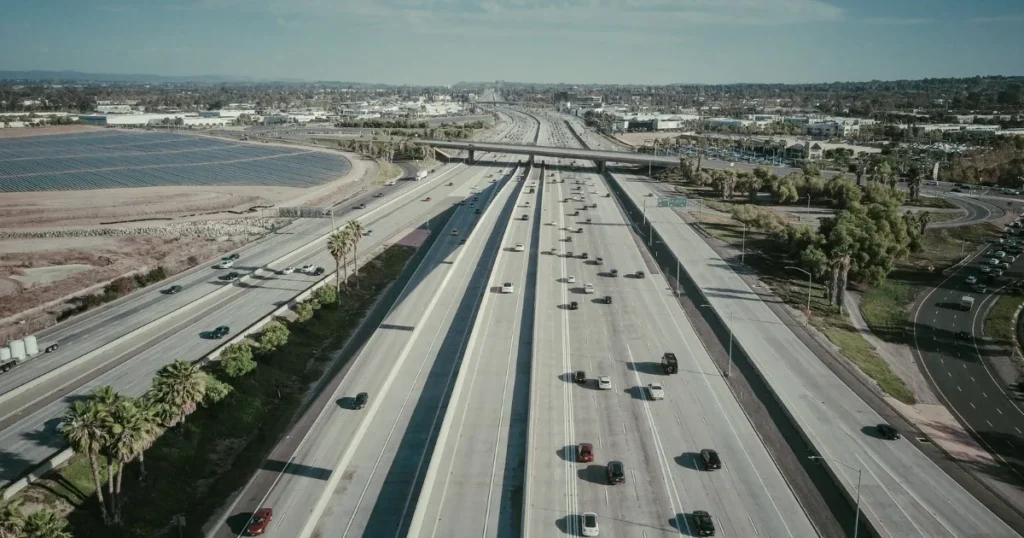
You are halfway through a wide intersection when you realize you are in the wrong lane. Do you move over now, or wait? Plenty of California drivers were told in driver’s ed that switching lanes in an intersection is illegal, and plenty of others do it every day without a second thought. If you have just been in a collision and someone is blaming you for the lane change, the answer suddenly matters a great deal.
Here is what California law actually says, and how it affects who pays after a crash.
The Short Answer: California Has No Specific Ban
The California Vehicle Code sections that govern lane changes contain no provision that specifically prohibits changing lanes inside an intersection.[1]
That surprises people, because the “you can’t change lanes in an intersection” rule is repeated so often it feels like statute. In California, the maneuver is governed by the same general rules that govern every other lane change, and those rules are strict enough that an intersection lane change often breaks them anyway.
So the honest answer is not “it’s legal.” It is closer to: there is no general statewide rule against the location, but there are firm rules about the manner, and an intersection is where that manner is hardest to get right.
The Three Rules That Govern Every Lane Change
Three sections of the Vehicle Code do the real work.
You may only move when it is safe, and you must signal. Under Vehicle Code section 22107, no driver may turn a vehicle from a direct course or move right or left on a roadway “until such movement can be made with reasonable safety and then only after the giving of an appropriate signal” when any other vehicle may be affected.[2]
The signal has to come early enough. Vehicle Code section 22108 requires that a signal of intention to turn right or left “shall be given continuously during the last 100 feet traveled by the vehicle before turning.”[3]
You have to stay in your lane until you can leave it safely. Vehicle Code section 21658(a) requires that a vehicle “be driven as nearly as practical entirely within a single lane” and not be moved from the lane “until such movement can be made with reasonable safety.”[4]
Read together, these do not ask where you changed lanes. They ask whether the movement was reasonably safe and properly signaled. That is the question an insurance adjuster, and eventually a jury, will actually be answering.
Why an Intersection Is Still the Worst Place to Do It
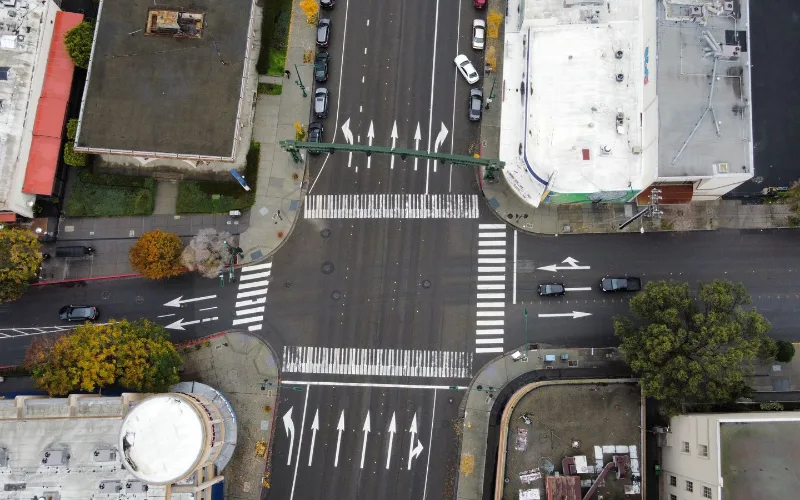
Even without a location-specific ban, an intersection stacks the odds against a clean lane change. Lane lines are often interrupted or absent through the crossing. Cars are entering from two more directions. Drivers around you are watching the signal head, not their mirrors. Turning traffic is crossing your path. Cyclists and pedestrians are in the mix.
All of that makes it harder to say the movement was made ‘with reasonable safety’, which is the exact phrase the statute turns on. A lane change that would be unremarkable on an open stretch of freeway can look very different when it happened in the middle of a crossing.
There is also a practical point worth knowing: an officer can cite you for an unsafe lane change based on how you moved, even if you believe the location itself was permitted. The citation is not about the intersection. It is about the safety and the signal.
How a Lane-Change Violation Becomes Fault for a Crash
This is where a traffic question becomes an injury question.
California law lets a traffic-law violation do real work in a civil case. Under Evidence Code section 669, a person’s failure to use due care is presumed if four things are true: the person violated a statute or regulation; the violation proximately caused the injury; the injury was the kind the law was designed to prevent; and the injured person was in the class the law was meant to protect.[5]
In plain terms: if a driver made an unsafe lane change, that violation caused the crash, and you were the kind of road user the lane-change rules exist to protect, the law starts from the position that the driver was negligent. It is a presumption, not an automatic win; it can be rebutted, and all four elements have to be established first. But it changes the starting point of the conversation.
What If You’re Told the Crash Was Partly Your Fault?
Being partly at fault does not end a California claim.
California follows pure comparative negligence: the California Supreme Court replaced the old “all-or-nothing” contributory negligence rule with “a system of ‘pure’ comparative negligence” in Li v. Yellow Cab Co.[6] Practically, that means an injured person’s recovery is reduced in proportion to their own share of responsibility rather than wiped out by it.
That matters in lane-change cases specifically, because fault is so often split. The other driver merged without looking; you were going a little fast. Both can be true, and both get weighed. We cover how that apportionment works in more detail in our guide to comparative negligence in California car accidents, and how a similar analysis plays out in rear-end collisions.
What Actually Helps Prove What Happened

Lane-change collisions frequently come down to one driver’s word against another’s. A few things carry more weight than memory:
Photographs of both vehicles before they are moved, showing where the damage sits. Sideswipe damage patterns often say a great deal about who moved into whom.
The position of the cars and any debris, photographed in place if it is safe to do so.
Names and numbers for any independent witness; someone with no stake in the outcome is worth a great deal.
Nearby camera footage. Intersections are among the most heavily filmed places on a road, between traffic cameras, business security cameras and dash cams. That footage is often overwritten within days, so it is worth identifying quickly.
Prompt medical attention, and a record of it. Symptoms from a sideswipe or a spin-out are not always obvious at the scene. Cyclists have their own set of rules to be aware of here too. See our guide to California bicycle laws.
Frequently Asked Questions
Is it legal to change lanes in an intersection in California?
The Vehicle Code sections governing lane changes contain no provision that specifically prohibits it. The general lane-change rules still apply, so the movement must be reasonably safe and properly signaled, and local ordinances, signage, or lane markings can restrict a movement at a specific intersection.[1]
Can I get a ticket for switching lanes in an intersection?
Yes, but not for the location itself, but for the manner. If the movement was not made with reasonable safety or was not properly signaled, an officer can cite the driver under the general lane-change provisions.[2][4]
How far ahead do I have to signal before I change lanes?
Section 22108 requires a continuous signal during the last 100 feet before turning. Whether that figure applies to a lane change as opposed to a turn is a question worth raising with an attorney if a citation or a fault dispute turns on it.[3]
The other driver changed lanes into me. Does that automatically make it their fault?
Not automatically. It is strong evidence, and a proven violation can trigger the negligence presumption in Evidence Code section 669. But the presumption can be rebutted, and your own conduct is weighed too.[5]
How long do I have to bring a claim in California?
The general deadline for a personal injury action in California is two years. Deadlines can be shorter or different in some situations, and certain circumstances can move the date, so it is worth confirming yours early rather than assuming.[7]
Talk It Through With Someone
If you were hurt in a lane-change collision and the fault story you are being told does not match what you remember, you do not have to sort out the Vehicle Code on your own. Bring your photos, the exchange-of-information form, and anything the other driver’s insurer has sent you, and our team will look at it with you and explain your options. Our practice focuses on California personal injury claims, consultations are free, and there is no obligation.
Sources and Notes
[1] This article states that the Vehicle Code sections governing lane changes (§§ 22107, 22108, and 21658) regulate the manner of the movement and contain no location restriction barring a lane change within an intersection. Limiting note: local ordinances, posted signage, and lane markings can independently restrict a movement in a specific intersection, and this article does not address those.
[2] Cal. Veh. Code § 22107: “No person shall turn a vehicle from a direct course or move right or left upon a roadway until such movement can be made with reasonable safety and then only after the giving of an appropriate signal in the manner provided in this chapter in the event any other vehicle may be affected by the movement.” Limiting note: the signal requirement is conditioned on another vehicle possibly being affected.
[3] Cal. Veh. Code § 22108: “Any signal of intention to turn right or left shall be given continuously during the last 100 feet traveled by the vehicle before turning.” Important limiting note: the statute as written refers to turning. Whether the 100-foot requirement applies to a lane change as distinct from a turn is a genuine interpretive question, and this article deliberately does not assert that it does.
[4] Cal. Veh. Code § 21658(a): “A vehicle shall be driven as nearly as practical entirely within a single lane and shall not be moved from the lane until such movement can be made with reasonable safety.” Limiting note: § 21658 applies where a roadway has been divided into two or more clearly marked lanes for traffic in one direction, and lane markings are frequently interrupted through an intersection, which is itself relevant to how the section applies there. (§ 21658 is the lane-change safety provision; § 21658.1 is motorcycle lane splitting, a different rule.)
[5] Cal. Evid. Code § 669(a): negligence is presumed where (1) the person violated a statute, ordinance or regulation of a public entity; (2) the violation proximately caused death or injury to person or property; (3) the death or injury resulted from an occurrence of the nature the enactment was designed to prevent; and (4) the injured person was one of the class of persons for whose protection the enactment was adopted. Limiting note: all four elements must be established, and § 669(b) provides for rebuttal. This is a presumption affecting the burden of proof, not a finding of liability.
[6] Li v. Yellow Cab Co. (1975) 13 Cal.3d 804: the “all-or-nothing” rule of contributory negligence was “superseded by a system of ‘pure’ comparative negligence.” Limiting note: how fault is actually apportioned between drivers is a question of fact decided on the evidence in each case. This article states no figure or typical split, because there is no typical split.
[7] Cal. Code Civ. Proc. § 335.1 (two years for an action for injury to, or death of, an individual caused by the wrongful act or neglect of another). Limiting note (read this one carefully): two years is the general rule, not a universal one. Claims against a public entity run on a much shorter and different track under the Government Claims Act; claims involving minors, defendants who leave the state, or injuries not reasonably discoverable at the time can be tolled or accrue later; and other causes of action carry their own periods. Because tolling and delayed accrual are fact-dependent, this article deliberately declines to state which deadline applies to any reader and directs them to confirm it with their own attorney.
Attorney advertising. This article is provided by B&D Law Group, APLC, which maintains an office in Los Angeles, California. It is general information about California law and is not legal advice. Reading this article or contacting our firm does not create an attorney-client relationship. Every case depends on its own facts, and results will differ based on different facts. Past results do not guarantee a similar outcome, and no result is guaranteed.