

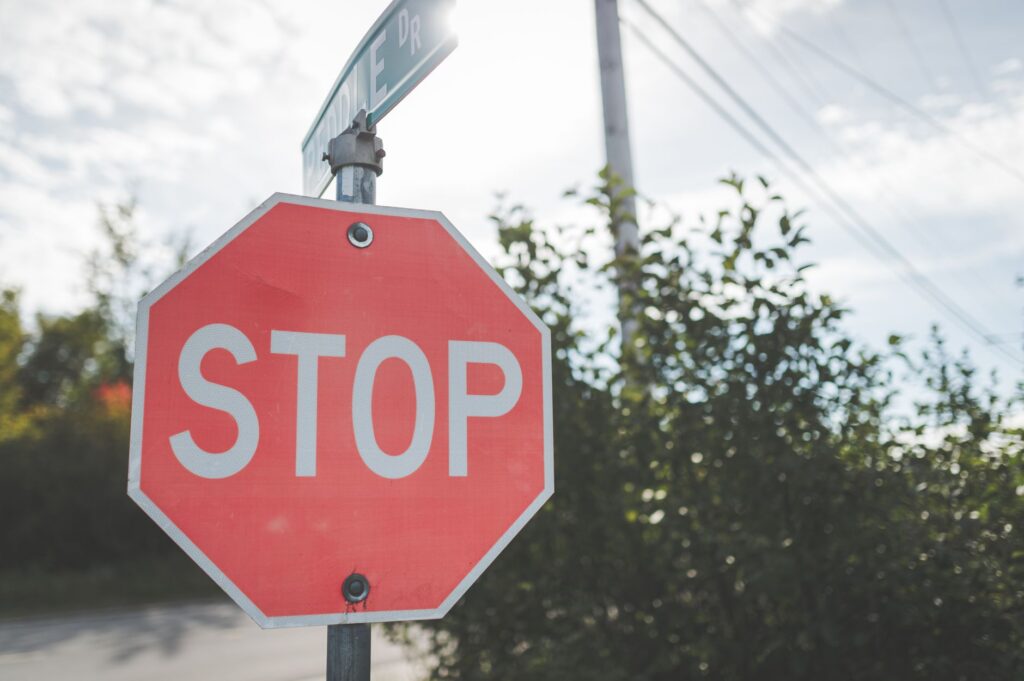
At a four-way stop in California, every driver must come to a complete stop, and the driver who arrives first has the right of way. When two vehicles arrive at the same time, the driver on the left must yield to the driver on the immediate right. The governing rule is Vehicle Code section 21800(c), together with the duty to stop in section 22450.
B&D Injury Law Group handles intersection collision claims across California. This article explains what the law actually requires at an all-way stop, the rule most articles get wrong, how right of way translates into fault, and what evidence decides these cases.
The Two Rules That Apply at a Four-Way Stop
Two separate obligations operate at an all-way stop, and they answer different questions.
The duty to stop. Vehicle Code section 22450(a) requires a driver approaching a stop sign to stop at the limit line if one is marked, and otherwise before entering the crosswalk on the near side of the intersection. If there is no crosswalk either, the stop must occur at the entrance to the intersecting roadway. This is a complete stop, not a slow roll.
The duty to yield. Vehicle Code section 21800(a) provides that a driver approaching an intersection shall yield the right of way to any vehicle which has entered the intersection from a different highway. In plain terms, a vehicle already in the intersection goes first, which in practice usually means the driver who stopped first. Section 21800(c) then handles the tie: when two vehicles enter an intersection from different highways at the same time and the intersection is controlled from all directions by stop signs, the driver of the vehicle on the left shall yield to the vehicle on the immediate right.
The Mistake Almost Every Article Makes
A great many websites state that Vehicle Code section 21802 governs four-way stops. It does not, and the statute says so itself.
Section 21802(a) requires a driver approaching a stop sign to stop and then yield to vehicles which have approached from another highway or which are approaching so closely as to constitute an immediate hazard. That is a meaningful rule, but subdivision (c) of the same section reads: this section does not apply where stop signs are erected upon all approaches to an intersection.
So section 21802 governs a two-way stop, where you face a stop sign and cross traffic does not. At a genuine four-way stop it is switched off by its own terms, and the operative pair is section 22450 for the stop and section 21800 for who proceeds. Getting this right matters, because the two sections impose different standards. Under section 21802 you must yield to traffic approaching so closely as to constitute an immediate hazard, even if it has not arrived. Under section 21800 at an all-way stop, the vehicle that entered the intersection first has the right of way, with a yield-to-the-right tiebreaker.

Three Intersection Scenarios, Three Different Rules
| Intersection type | Duty to stop | Who has the right of way |
|---|---|---|
| Uncontrolled, no signs or signals | None | Section 21800(a), first to enter. On a tie, section 21800(b)(1): yield to the right, unless you are on a terminating highway |
| Two-way stop, sign on your approach only | Section 22450 | Section 21802(a): stop, then yield to cross traffic already approaching or constituting an immediate hazard |
| Four-way or all-way stop | Section 22450 | Section 21800(a) first to enter; section 21800(c) tie goes to the vehicle on the right |
One drafting detail is worth noticing. The tiebreaker at an uncontrolled intersection in section 21800(b)(1) carries an exception for a terminating highway, meaning a road that ends at the intersection rather than continuing through. Section 21800(c), the all-way stop tiebreaker, contains no such exception. At a four-way stop it is a pure yield-to-the-right rule.
What Happens When a Signal Goes Dark
Drivers encounter this after storms and outages and often handle it badly. Section 21800(d)(1) provides that when traffic signals are inoperative, a driver must stop at the intersection and may then proceed with caution when it is safe to do so. Under section 21800(d)(2), on simultaneous arrival the driver on the left yields to the driver on the right, except that a driver on a terminating highway yields to traffic on the continuing highway.
A dark signal is treated as an all-way stop. Treating it as a free-for-all, or assuming your direction retains priority because it is the larger road, is a common and expensive error.

How a Right-of-Way Violation Becomes Legal Fault
Violating one of these sections does not automatically make a driver liable, but it comes close, through a doctrine called negligence per se.
Evidence Code section 669 creates a presumption that a person failed to exercise due care if four things are shown: the person violated a statute, ordinance or regulation; the violation proximately caused death or injury; the injury resulted from an occurrence of the nature the law was designed to prevent; and the injured person was one of the class the law was adopted to protect.
For the right-of-way statutes, the third and fourth elements are essentially automatic. These are traffic safety laws written to prevent exactly this kind of collision, and other road users are exactly the class they protect. The real contest is usually causation, and then rebuttal.
The presumption can be rebutted. Section 669(b) allows a violator to show he did what might reasonably be expected of a person of ordinary prudence acting under similar circumstances who desired to comply with the law. A driver who stopped, looked, and pulled out because a parked delivery truck hid the approaching car is making a rebuttal argument.
It is worth being precise about what negligence per se is. It is an evidentiary presumption that establishes the standard of care. It is not a separate cause of action, and it does not relieve an injured person of proving causation and damages.
Comparative Fault at Intersections
Four-way stop collisions frequently produce shared fault, and California handles that with pure comparative negligence under Li v. Yellow Cab Co. (1975) 13 Cal.3d 804. Damages are reduced in proportion to a plaintiff’s own share of fault, and there is no percentage that cuts off recovery entirely. A driver found 60 percent responsible still recovers 40 percent of proven damages.
This matters because the classic pattern is a driver with the right of way who was also speeding, distracted, or rolling the stop. Having the right of way is not the same as having no duty of care.
Evidence That Decides These Cases
Arrival order is the central fact and it is rarely captured cleanly. Because these collisions usually come down to two drivers each certain they stopped first, independent evidence carries disproportionate weight.
Look for video before it disappears. Doorbell cameras, business security systems, transit and delivery vehicle cameras, and dashcams retain footage for days rather than months. A written preservation request sent early is often the difference between having video and hearing that it was overwritten.
Physical evidence helps establish geometry. Point of impact, debris field, resting positions and crush patterns can indicate which vehicle was further into the intersection and how fast each was moving. Modern vehicle event data recorders can capture pre-crash speed and brake application.
Independent witnesses matter more here than in most collision types, precisely because the drivers’ accounts conflict by default. Get names at the scene rather than relying on the report to capture them.
Practical Points Drivers Get Wrong
Waving another driver through feels courteous and creates real problems. It is not a transfer of right of way, and a driver who waves someone into the path of a vehicle they could not see can be drawn into the resulting claim.
A rolling stop is a violation even when nothing is coming. If a collision follows, the rolling stop supplies the statutory violation that anchors a negligence per se argument.
Pedestrians retain the right of way in marked and unmarked crosswalks under Vehicle Code section 21950, and a driver’s turn at a four-way stop does not override a pedestrian already crossing.
Who has the right of way at a four-way stop in California?
The driver who arrives and stops first proceeds first, under Vehicle Code section 21800(a). If two vehicles arrive at the same time, section 21800(c) gives the right of way to the vehicle on the right, and the driver on the left must yield.
Does Vehicle Code section 21802 apply at a four-way stop?
No. Section 21802(c) states that the section does not apply where stop signs are erected on all approaches to an intersection. Section 21802 governs two-way stops. At an all-way stop, section 22450 requires the stop and section 21800 determines who goes.
What do I do when a traffic light is out?
Treat it as an all-way stop. Section 21800(d)(1) requires you to stop at the intersection and then proceed with caution when it is safe. If two vehicles arrive together, the driver on the left yields to the driver on the right, unless the driver on the left is on a continuing road and the other is on a terminating road (section 21800(d)(2)).
If the other driver ran the stop sign, is the case automatic?
Not automatic, but strong. A violation triggers the negligence per se presumption under Evidence Code section 669, which shifts the practical burden. The other driver can still contest causation or offer an excuse, and your own conduct can reduce recovery under comparative fault.
Can I recover if I was partly at fault?
Yes. California follows pure comparative negligence under Li v. Yellow Cab Co. Your damages are reduced by your percentage of fault, but there is no cutoff that bars recovery.
If you were hurt in an intersection collision anywhere in California, the arrival-order evidence is worth preserving quickly. Learn more about car accident claims, read about pedestrian accident cases, or contact B&D Injury Law Group for a free consultation.
This article is provided for general informational purposes only and does not constitute legal advice. Reading it does not create an attorney-client relationship. Every case is different and past results do not guarantee a similar outcome. If you have been injured, speak with a licensed attorney about your specific situation.