

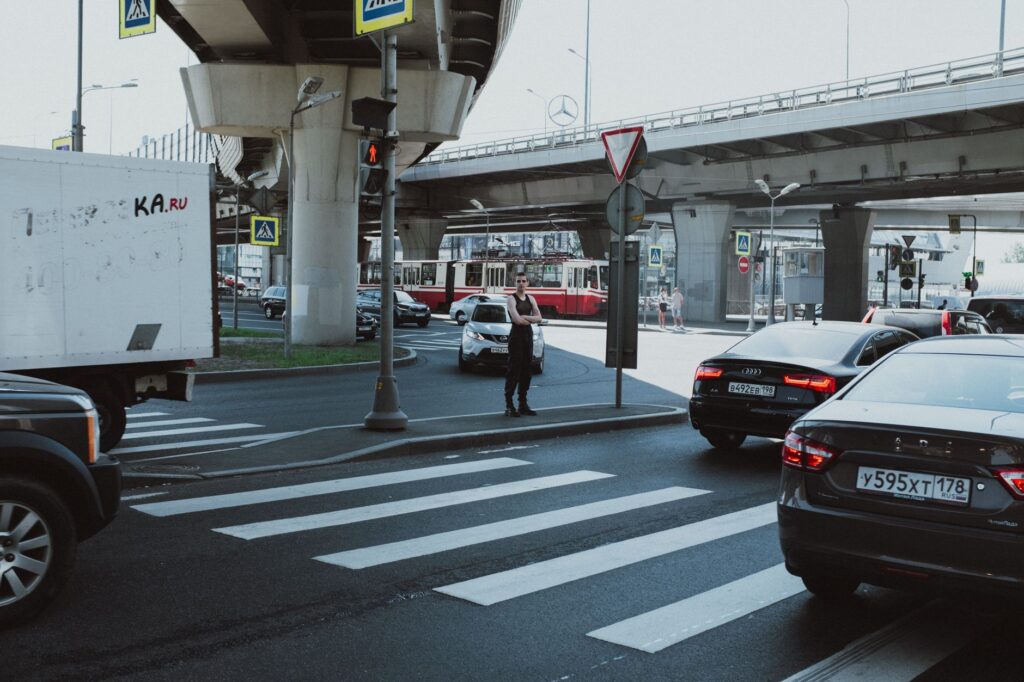
Fault in a T-bone collision goes to whichever driver failed to yield the right of way, and California’s Vehicle Code assigns that in three main situations. Section 21800 governs uncontrolled and simultaneous approaches, with the driver on the left yielding to the driver on the right. Section 21802 governs stop signs, requiring a driver to stop and then yield to vehicles approaching closely enough to constitute an immediate hazard. Section 21801 governs left turns, requiring the turning driver to yield to oncoming traffic close enough to be a hazard. The position of the damage is not by itself proof of who was at fault.
We are B&D Injury Law Group, and our team handles injury claims across California and in Las Vegas, Nevada. Side-impact collisions produce serious injuries and unusually contested liability, because the two drivers are approaching from different directions and each has a clear memory of a green light. Below: the right-of-way rules that actually decide these cases, the mistake people make in assuming the struck vehicle was blameless, and the evidence that resolves a disputed intersection.
The Three Right-of-Way Rules That Decide Most Cases
A T-bone is a right-of-way case. Almost every one resolves under one of three Vehicle Code sections.
Section 21800 covers intersections without a functioning signal. Subdivision (a) requires a driver approaching an intersection to yield to a vehicle that has already entered the intersection from a different highway. Subdivision (b) covers simultaneous arrival: the driver on the left yields to the driver on the right, except that a driver on a terminating highway yields to a driver on the continuing highway. Subdivision (c) applies the same left-yields-to-right rule at all-way stops. Subdivision (d) handles a malfunctioning signal, requiring drivers to stop and proceed cautiously, then applying the same priority rules.
Section 21802 covers stop signs. A driver approaching a stop sign must stop as required by section 22450, then yield to vehicles that have approached from another highway or that are approaching so closely as to constitute an immediate hazard, and that duty continues until the driver can proceed with reasonable safety. Subdivision (b) then flips the obligation: once a driver has yielded as required and enters the intersection, other approaching drivers must yield to them.
Section 21801 covers left turns. A driver intending to turn left or make a U-turn must yield to all vehicles approaching from the opposite direction that are close enough to constitute a hazard, and must continue yielding until the turn can be completed with reasonable safety. Subdivision (b) again flips it: once the turning driver has yielded and given the required signal, oncoming drivers must yield to the turning vehicle.
Stopping Is Not the Same as Yielding
The most common misunderstanding in these cases is the belief that stopping at a stop sign discharges the driver’s obligation. It does not.
Section 21802 imposes two separate duties. The first is to stop as section 22450 requires. The second, which is where liability usually attaches, is to yield to any vehicle approaching closely enough to constitute an immediate hazard, and to keep yielding until the driver can proceed with reasonable safety. A driver who stops fully, then pulls into the path of cross traffic, has complied with the first duty and breached the second.
The same structure appears in section 21801. A left-turning driver who has a green ball rather than a green arrow has permission to be in the intersection, not priority over oncoming traffic. The duty to yield continues until the turn can be completed safely.
| Intersection type | Governing section | Who must yield |
|---|---|---|
| No signal, one vehicle already in the intersection | CVC 21800(a) | The approaching driver |
| No signal, simultaneous arrival | CVC 21800(b) | The driver on the left |
| All-way stop | CVC 21800(c) | The driver on the left |
| Two-way stop | CVC 21802 | The driver facing the stop sign |
| Left turn across oncoming traffic | CVC 21801 | The turning driver |
| Malfunctioning signal | CVC 21800(d) | Stop first, then the driver on the left |
Being Hit in the Side Does Not Prove You Were Right
Adjusters and drivers both tend to treat the damage pattern as the answer: the car with front damage hit the car with side damage, so the front-damaged car was at fault. It is a reasonable first inference and it is wrong often enough to matter.
A driver who enters an intersection against a red light will typically be struck in the side by cross traffic with the green. In that geometry the driver who ran the light is the one with side damage. Physical damage establishes the angle of impact, not the sequence of events or who had the right of way.
The second complication is that these cases are frequently shared. A driver with a green light who was speeding, or who could have avoided the collision with reasonable attention, can carry a share of the fault even though the other driver clearly failed to yield. California’s pure comparative fault rule from Li v. Yellow Cab Co. (1975) divides damages by percentage of responsibility with no cutoff, so a driver found 25 percent responsible recovers 75 percent.
What Resolves a Disputed Intersection
When both drivers claim a green light, the case is decided by evidence external to either account.
Independent witnesses matter most and are hardest to keep. Anyone who stopped at the scene should be recorded by name and number immediately, because a witness who leaves is generally unrecoverable.
Video is the strongest evidence available and the shortest-lived. Intersection cameras, transit vehicles, nearby businesses, and other drivers’ dashcams commonly overwrite within days to a few weeks. Identifying which cameras face the intersection and requesting preservation in writing quickly is often the difference in a disputed case.
Many modern cars have event data recorders that can capture speed, braking and throttle in the seconds before impact. That data can be lost when a vehicle is repaired or sold for salvage, so preserving the vehicle matters.
Signal timing records held by the municipal traffic authority can establish whether the light sequence was consistent with a driver’s account. The physical evidence at the scene, meaning the point of impact, debris field, skid or scuff marks and final rest positions, allows a reconstruction of approach speeds and angles.
Where a public entity’s signal was malfunctioning or an obstruction blocked sightlines, a claim against the entity may be available under Government Code section 835, subject to the six-month written claim deadline in Government Code section 911.2. For ordinary claims, Code of Civil Procedure section 335.1 gives two years from the date of injury.
Why Side Impacts Injure More Severely
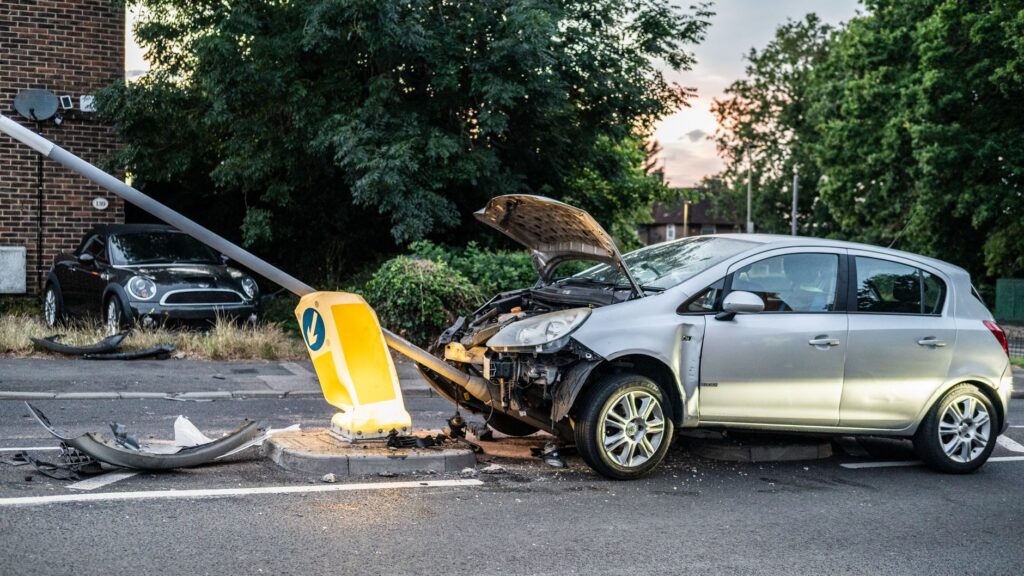
A side impact places the occupant close to the point of intrusion with only the door structure between them and the striking vehicle, unlike a frontal impact where the engine compartment and crumple zone absorb energy over a longer distance.
That geometry produces a recognizable pattern of serious injury, and two features of it matter for a claim. Head injuries in side impacts frequently present with delayed symptoms, and internal injuries can be asymptomatic for hours. Anyone who feels able to decline transport should still be evaluated the same day, both for their own sake and because a gap between the collision and the first medical record is the argument insurers use most reliably on causation.
Frequently Asked Questions
Who is usually at fault in a T-bone accident?
The driver who failed to yield the right of way. Which driver that is depends on the intersection: Vehicle Code section 21802 puts the duty on the driver facing a stop sign, section 21801 puts it on a driver turning left across oncoming traffic, and section 21800 puts it on the driver on the left where vehicles arrive simultaneously at an uncontrolled intersection or all-way stop.
Is the driver who gets hit in the side always the innocent one?
No. A driver who runs a red light is typically struck in the side by cross traffic that had the green, so side damage is common on the at-fault vehicle. Damage location establishes the angle of impact, not who had the right of way.
Does stopping at a stop sign mean I had the right of way?
No. Vehicle Code section 21802 imposes two duties: stop as required by section 22450, and then yield to vehicles approaching so closely as to constitute an immediate hazard, continuing to yield until you can proceed with reasonable safety. Stopping satisfies only the first. Most stop sign liability arises from the second.
Who is at fault when a left-turning car is hit?
Usually the turning driver. Vehicle Code section 21801(a) requires a driver turning left to yield to all vehicles approaching from the opposite direction that are close enough to constitute a hazard, and to continue yielding until the turn can be made with reasonable safety. A green ball signal permits the turn but does not confer priority over oncoming traffic. Under subdivision (b), once the turning driver has yielded and signaled, oncoming drivers must then yield to them.
What if both of us say we had a green light?
The case is decided on independent evidence: witnesses, camera footage, signal timing records from the traffic authority, vehicle event data recorder downloads, and scene physical evidence such as the point of impact and debris field. Most of that evidence degrades within days, so preservation requests need to go out quickly.
If you were hurt in a side-impact collision and the other driver is describing a different light than you remember, we would like to hear what happened. Our team handles car accident claims, catastrophic injury claims and truck accident claims. Contact us quickly, because intersection video is often overwritten within days to a few weeks.
This article is provided for general informational purposes only and does not constitute legal advice. Reading it does not create an attorney-client relationship. Every case is different and past results do not guarantee a similar outcome. If you have been injured, speak with a licensed attorney about your specific situation.