

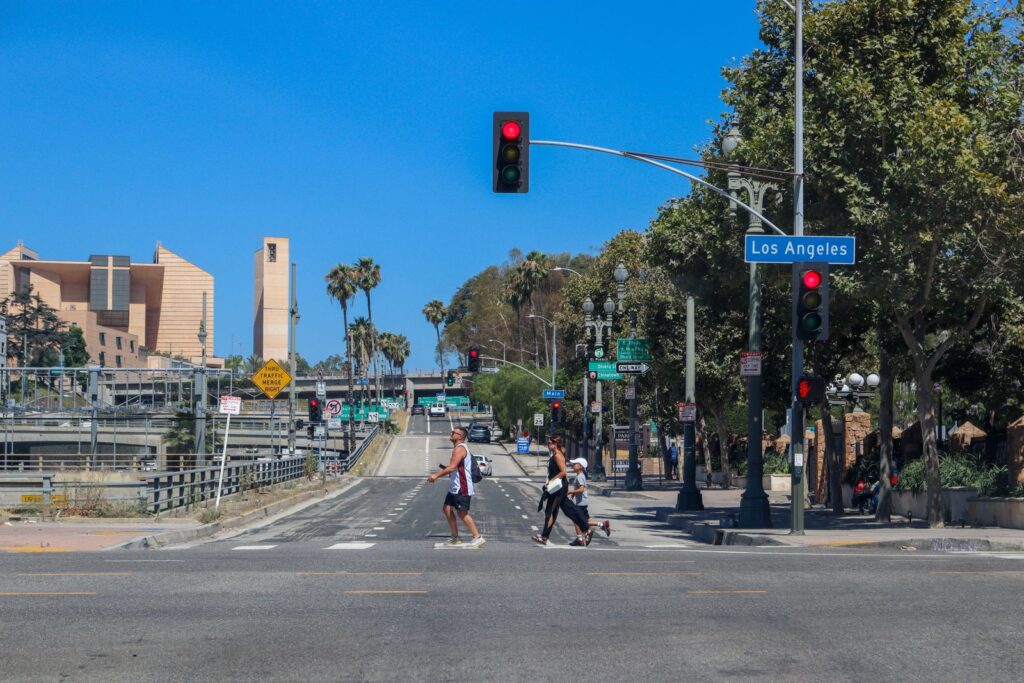
In October 2026, the Wall Street Journal looked closely at a 1.5-mile stretch of Union Avenue in Memphis, Tennessee, one of the most dangerous roads in the country for people on foot. The road has six lanes of traffic and crosswalks as far as half a mile apart. People have to cross this road every day. The road gives them very few safe places to do that, which makes it a textbook setting for a pedestrian accident.
Memphis is an extreme example, but it is not a rare one. The same kind of road exists in nearly every city in America, including right here in Los Angeles. If you walk to work, to the bus, to the store or to school, you share the street with traffic that was built to move fast, not to stop for you.
The numbers behind the issue
Smart Growth America’s Dangerous by Design 2026 report found that 7,080 people were hit and killed while walking in the United States in 2024. That is more than 19 people every day. Pedestrian deaths increased by 72 percent from 2009 to 2024, faster than both population growth and the total miles Americans drive. During that time, pedestrian deaths dropped in most other developed countries.
There has been some improvement. The Governors Highway Safety Association projects that 6,732 pedestrians were killed in 2025, down 7 percent from the year before and the third straight annual drop. Still, that number is 5 percent higher than in 2019, before the pandemic.
The same report highlights a few trends that matter for anyone who walks:
- SUVs and pickup trucks are involved in more than half of pedestrian deaths.
- Distracted driving is becoming more common. In 2024, 21.7 percent of pedestrian deaths involved a distracted driver, up from 15.6 percent in 2019.
- Nearly one in four pedestrian deaths is a hit-and-run.
Memphis is still the deadliest metro area for walkers in the country, with 5.5 pedestrian deaths per 100,000 residents. When Dangerous by Design first ranked metro areas in 2009, no metro area was higher than 3.52.
Why roads like this are so dangerous
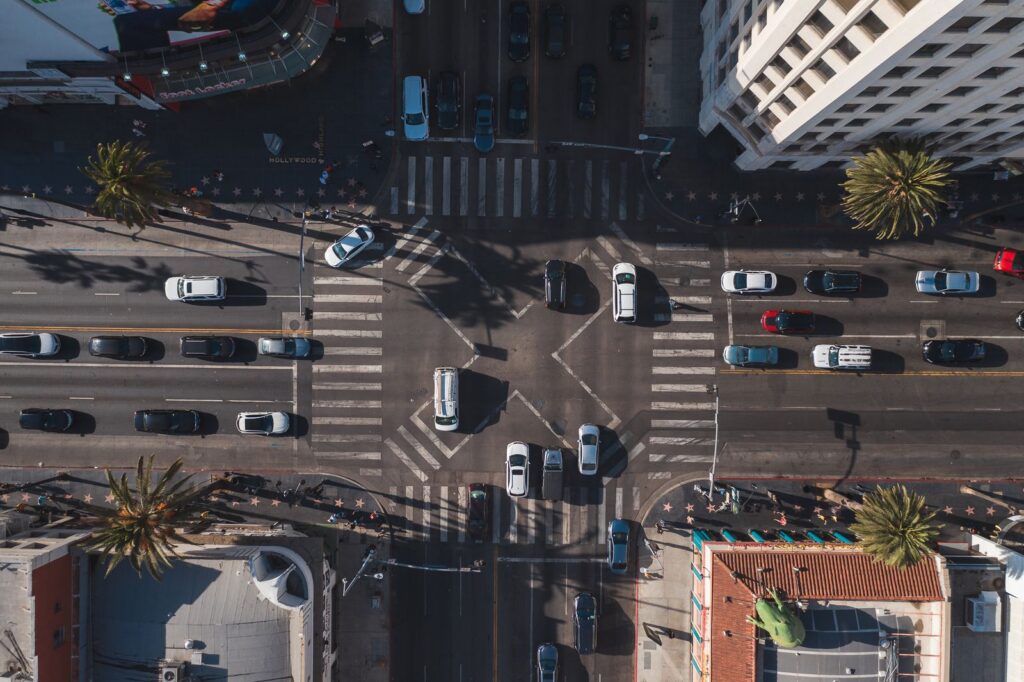
Safety researchers keep seeing the same pattern. The worst roads are wide, fast arterials with long gaps between signals, lined with businesses that people walk to every day. Jessica Lotz, executive director of Innovate Memphis, has described Union Avenue as a six-lane road with no turn lane, where the sidewalks run directly through the driveways and parking of a busy commercial strip.
This design creates predictable dangers:
- Long distances between crosswalks. When the nearest signal is a quarter mile away, people cross mid-block. Drivers are not expecting them.
- High speeds. Wide lanes make high speeds feel normal to a driver. Research from the AAA Foundation for Traffic Safety found that a vehicle going 42 mph is five times more likely to kill a pedestrian it hits than one going 25 mph.
- Many lanes to cross. A driver in one lane may stop for a pedestrian while the driver in the next lane, whose view is blocked, keeps going.
- Constant turning traffic. Driveways and intersections mean drivers are looking for gaps in traffic, not for people on foot.
None of this makes walking wrong. It means the person walking is carrying risk they did nothing to create.
What California law says about pedestrians
California gives pedestrians real protection, and it also expects everyone on the road to use care.
Drivers must yield at crosswalks. Under California Vehicle Code section 21950, a driver must yield the right-of-way to a pedestrian crossing within any marked crosswalk, or within an unmarked crosswalk at an intersection. Drivers approaching a pedestrian in a crosswalk must slow down or take whatever other action is needed to keep that person safe. Many intersections have an unmarked crosswalk even where no lines are painted.
Crossing mid-block is not automatically your fault. California’s Freedom to Walk Act (AB 2147), which took effect January 1, 2023, changed Vehicle Code section 21955. Police may not stop a pedestrian for crossing outside a crosswalk unless a reasonably careful person would realize there was an immediate danger of a collision. The law also says clearly that drivers still owe a duty of care to any pedestrian in the roadway.
Shared fault does not erase your claim. California uses comparative fault. If a pedestrian is found partly responsible, their compensation can be reduced by their share of fault, but they are not automatically barred from recovering.
Sometimes the road itself is part of the case. When a public road has a dangerous condition, such as a missing or faded crosswalk, a broken signal, poor lighting or a hazard the city knew about and did not fix, the government agency responsible for it may share liability under California Government Code section 835.
Deadlines are short, especially against the government
Most personal injury claims in California must be filed within two years of the injury under Code of Civil Procedure section 335.1. But if a city, county or state agency might be responsible, the timeline is much shorter. Under Government Code section 911.2, a written claim generally has to be presented to the agency within six months. Miss that window and the claim against the agency can be lost.
That is one reason it helps to talk to a lawyer early, while evidence like traffic camera footage, signal timing records and witness information can still be preserved.
What to do if you are hit while walking
- Get medical care as soon as possible. Some injuries, including head injuries and internal bleeding, do not show symptoms right away.
- Call the police so there is an official report, especially if the driver leaves the scene.
- Take pictures of the scene if you can: the vehicle, the road, the crosswalk or lack of one, the lighting and any signals.
- Gather contact information from the driver and any witnesses.
- Be careful with insurance adjusters. Do not give a recorded statement or sign anything before you understand your rights.
- Talk to a personal injury attorney about the driver’s responsibility and whether the road design may also be part of the case.
B&D Injury Law Group can help
Being a pedestrian should not mean accepting the risk of being seriously hurt. But on roads built for speed, people on foot are the ones who pay the price when something goes wrong. Medical bills, lost work and long recoveries can follow one moment at an intersection.
B&D Injury Law Group handles pedestrian accident cases in Los Angeles and across California. We look at every party who may be responsible, from the driver and their insurer to the agency that designed or maintained the road. Every case depends on its own facts, and we will give you an honest look at yours.
If you or someone you love was hurt while walking, call B&D Injury Law Group at (888) 977-2238 for a free consultation.
Sources: Smart Growth America, Dangerous by Design 2026; Governors Highway Safety Association, Pedestrian Traffic Fatalities by State: 2025 Preliminary Data; AAA Foundation for Traffic Safety; The Wall Street Journal; California Vehicle Code sections 21950 and 21955; California Government Code sections 835 and 911.2; California Code of Civil Procedure section 335.1.
Attorney advertising. This article is general information, not legal advice. Reading it or contacting us does not create an attorney-client relationship. Every case is different, and results will differ based on different facts. Past results do not guarantee a similar outcome, and no result is guaranteed. B&D Law Group, APLC, Los Angeles office: 10700 Santa Monica Blvd, Suite 200.