

Quick answer
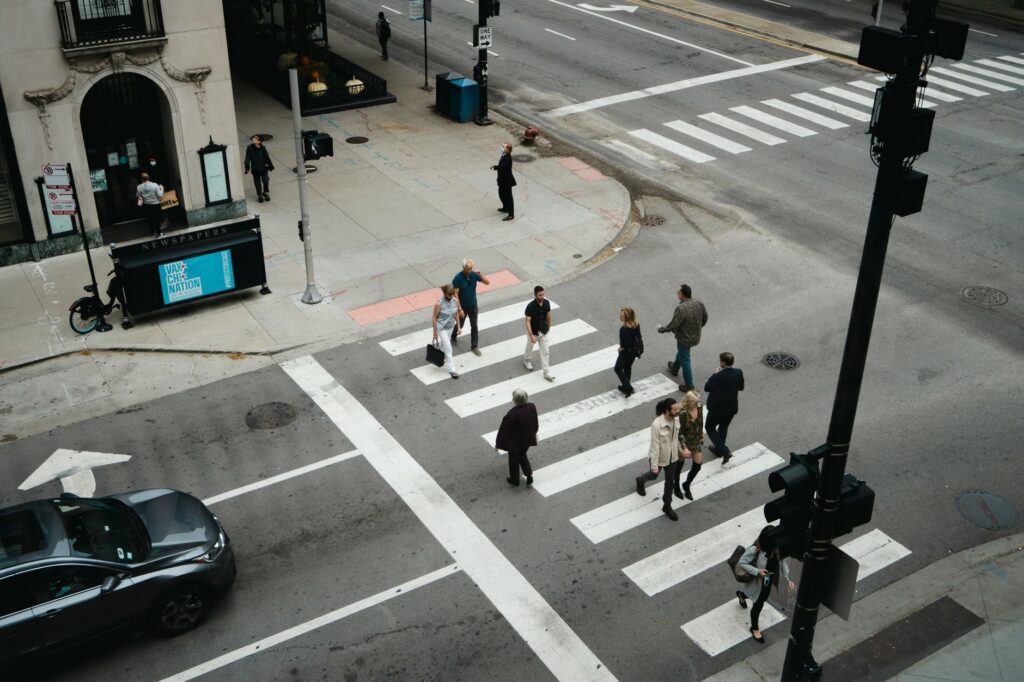
Crossing mid-block is still prohibited between adjacent signal-controlled intersections under Vehicle Code section 21955(a), but police may not stop you for it unless a reasonably careful person would see an immediate danger of collision. Both pedestrians and drivers still owe due care. If you are hit while jaywalking, your share of fault reduces your recovery but does not bar it.
Crossing outside a crosswalk is still restricted in California, but it is no longer freely enforceable. Vehicle Code section 21955(a) continues to provide that between adjacent intersections controlled by traffic signals or police officers, pedestrians shall not cross except in a crosswalk. The Freedom to Walk Act added subdivision (b)(1), which prohibits a peace officer from stopping a pedestrian for that violation unless a reasonably careful person would realize there is an immediate danger of a collision. The statute expressly preserves both the pedestrian’s duty of due care and the driver’s.
We are B&D Injury Law Group, and our team handles injury claims across California and in Las Vegas, Nevada. Since the Freedom to Walk Act took effect, we have heard two opposite and equally wrong summaries of it: that jaywalking is now legal in California, and that nothing changed. Neither is right, and the difference matters a great deal to anyone hurt while crossing a street. Below: what section 21955 says now, what it does not say, and how a mid-block crossing actually affects an injury claim.
What Section 21955 Says Now
Subdivision (a) is unchanged and still states the rule: between adjacent intersections controlled by traffic control signal devices or by police officers, pedestrians shall not cross the roadway at any place except in a crosswalk. Note how narrow that is. It applies between two adjacent signal-controlled or officer-controlled intersections, not to every street in California.
Subdivision (b)(1) is the addition. A peace officer shall not stop a pedestrian for a violation of subdivision (a) unless a reasonably careful person would realize there is an immediate danger of a collision with a moving vehicle or other device moving exclusively by human power.
Subdivisions (b)(2) and (b)(3) do the work that most summaries skip. Subdivision (b)(2) provides that the section does not relieve a pedestrian of the duty to exercise due care for their own safety. Subdivision (b)(3) provides that it does not relieve a driver of the duty to exercise due care for the safety of pedestrians. The Legislature changed the enforcement threshold and deliberately left the civil duties exactly where they were.
What Changed and What Did Not
What changed is the citation. An officer watching someone cross an empty street mid-block at two in the morning may no longer stop them for it, because a reasonably careful person would not perceive an immediate danger of collision.
What did not change is the standard of care in a civil case. Crossing mid-block is still conduct a jury can weigh in deciding how responsibility is shared, because subdivision (b)(2) says so directly. Nor did the driver’s duty change: subdivision (b)(3) preserves it, and a driver who was speeding, distracted or failing to keep a proper lookout does not become blameless because the pedestrian was outside a crosswalk.
| Question | Answer under current law |
|---|---|
| Is mid-block crossing prohibited? | Between adjacent signal-controlled intersections, yes, under CVC 21955(a) |
| Can an officer stop you for it? | Only if a reasonably careful person would see an immediate danger of collision |
| Does the pedestrian still owe due care? | Yes, expressly preserved by CVC 21955(b)(2) |
| Does the driver still owe due care? | Yes, expressly preserved by CVC 21955(b)(3) |
| Does crossing mid-block bar an injury claim? | No. It affects the share of fault, not the right to recover |
The Crosswalk Rules That Sit Alongside It
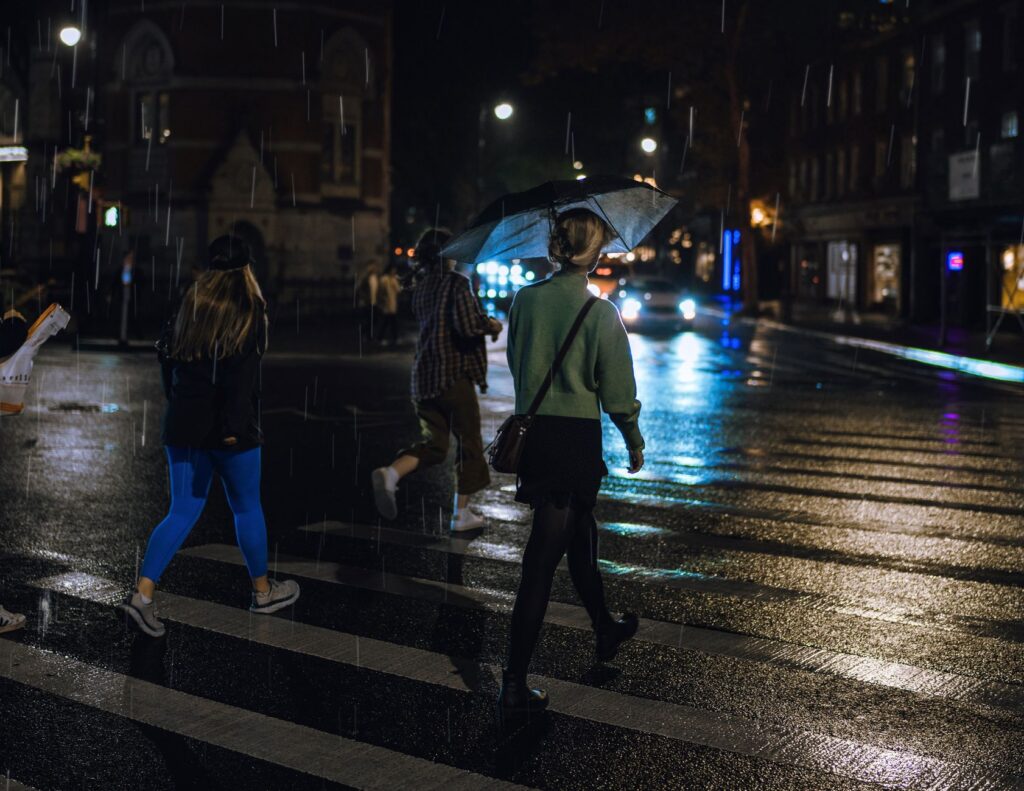
Section 21955 governs crossing between intersections. A separate set of rules governs crossings at intersections, and the two get confused constantly.
Vehicle Code section 21950(a) requires a driver to yield the right-of-way to a pedestrian crossing the roadway within any marked crosswalk or within an unmarked crosswalk at an intersection. The word unmarked is the one that surprises people. Under the definition in Vehicle Code section 275, a crosswalk exists at most intersections whether or not anyone painted lines on the road, formed by the prolongation of the sidewalk lines across the roadway. A pedestrian crossing at a corner with no paint is usually in a crosswalk as a matter of law.
Section 21950 is not one-sided. Subdivision (b) provides that the section does not relieve a pedestrian from the duty of using due care, and prohibits a pedestrian from suddenly leaving a curb into the path of a vehicle so close as to constitute an immediate hazard. Subdivision (c) requires drivers to exercise all due care and reduce speed or take other action needed to safeguard a pedestrian’s safety.
Vehicle Code section 21954 covers pedestrians crossing outside a crosswalk generally and requires them to yield the right-of-way to vehicles close enough to constitute an immediate hazard, while subdivision (b) makes clear that this does not relieve drivers of the duty to exercise due care.
How a Mid-Block Crossing Affects an Injury Claim
Under pure comparative fault, adopted in Li v. Yellow Cab Co. (1975), an injured pedestrian’s own negligence reduces the award by their percentage of responsibility and does not bar it. There is no cutoff at 50 percent as there is in many other states. A pedestrian found 60 percent responsible still recovers 40 percent of their damages.
That is the whole legal answer, and it is worth stating plainly because the opposite is asserted so often. An insurer’s first position in a mid-block case is frequently that the pedestrian was jaywalking and therefore has no claim. That is not California law.
What actually determines the split is the driver’s conduct. Speed, phone records, headlight use, sightlines, whether the driver had time to perceive and react, and whether the pedestrian was visible for two seconds or two tenths of a second. In practice the strongest evidence tends to be physical: the point of impact on the vehicle, the throw distance, the position of debris, and any camera in the area, which is usually overwritten within days.
The Freedom to Walk Act also removed one recurring piece of prejudicial evidence. Where a pedestrian previously received a citation that an insurer could wave around, Vehicle Code section 21955(b)(1) now bars an officer from stopping a pedestrian for that crossing absent an immediate danger of collision. The absence of a citation is not proof the pedestrian did nothing wrong, but its presence is no longer available as shorthand for it.
If You Were Hit While Crossing
Get medical attention the same day, even if you feel able to walk away. Head and internal injuries commonly present late, and a delay of a week becomes an argument that something else caused the harm.
Ask police to write a report, and be careful about narrating fault at the scene while concussed or in shock. Photograph the roadway, the sightlines in both directions, the lighting, and any signal or crosswalk within a block in each direction, because whether adjacent intersections were signal-controlled determines whether section 21955(a) even applies.
Note the businesses and residences with cameras facing the street and ask for the footage quickly. If a city bus, a government vehicle or a dangerous roadway condition is involved, the Government Code section 911.2 six-month claim deadline applies and is much shorter than the two-year deadline in Code of Civil Procedure section 335.1 that governs ordinary claims.
Frequently Asked Questions
Is jaywalking legal in California now?
Not exactly. Vehicle Code section 21955(a) still prohibits crossing outside a crosswalk between adjacent intersections controlled by traffic signals or police officers. What the Freedom to Walk Act changed is enforcement: under subdivision (b)(1), an officer may not stop a pedestrian for that violation unless a reasonably careful person would realize there is an immediate danger of a collision with a moving vehicle or human-powered device.
Can I still get a jaywalking ticket in California?
Yes, but only where the immediate-danger threshold is met. If a reasonably careful person watching would perceive an immediate danger of collision, an officer may stop and cite. Crossing a clear street with no traffic in sight does not meet that standard.
Does jaywalking mean I cannot sue if a car hits me?
No. California applies pure comparative fault under Li v. Yellow Cab Co. (1975). Your own share of responsibility reduces the award proportionally, and short of being found entirely at fault there is no percentage at which recovery is cut off. Vehicle Code section 21955(b)(3) also expressly preserves the driver’s duty to exercise due care for pedestrian safety.
Do I have the right of way in an unmarked crosswalk?
Usually, yes. Vehicle Code section 21950(a) requires drivers to yield to pedestrians in a marked crosswalk or in an unmarked crosswalk at an intersection, and Vehicle Code section 275 defines a crosswalk to include the area formed by the prolongation of sidewalk lines at an intersection even where no lines are painted. Section 21950(b) still requires the pedestrian to use due care and not leave a curb suddenly into the path of a close vehicle.
How long do I have to file a claim after being hit as a pedestrian in California?
Two years from the date of injury under Code of Civil Procedure section 335.1 in an ordinary case. If a public entity is involved, such as a city bus or a dangerous condition on a public road, Government Code section 911.2 requires a written claim within six months before any lawsuit, and missing that deadline generally ends the claim against the government.
If you were hit while crossing, and an adjuster has already told you that jaywalking ends your claim, that is not what California law says. Our team handles pedestrian accident claims and car accident claims, and our Los Angeles personal injury page covers our California practice. Contact us before giving a recorded statement.
This article is provided for general informational purposes only and does not constitute legal advice. Reading it does not create an attorney-client relationship. Every case is different and past results do not guarantee a similar outcome. If you have been injured, speak with a licensed attorney about your specific situation.