

Quick answer
If you are a pedestrian hit by a car in California, get medical care first, then collect the driver's name, address, registration and insurance, witness contacts and photos. Drivers must yield in crosswalks and always use due care, and a pedestrian's own fault reduces damages rather than barring them. Most lawsuits must be filed within two years.
If you are a pedestrian hit by a car in California, the steps you take in the first hours can protect both your health and your right to compensation. People on foot have almost no protection in a crash, which is why these injuries are so often serious. B&D attorney Alina Dermendjian has discussed pedestrian safety and pedestrian claims on KGET 17 many times; watch the KGET 17 Studio 17 Live segment on preventing pedestrian accidents.
As discussed on KGET 17, Studio 17 Live (July 2026)
- Summer Safety: Attorney Alina Dermendjian, from B&D Law Group Shares How to Prevent Pedestrian Accidents, KGET 17 Studio 17 Live, July 2026, with Alina Dermendjian
- Studio 17: Staying Safe on Foot This Holiday Season, KGET 17 Studio 17 Live, December 2025, with Alina Dermendjian
- Studio 17: Pedestrian Accidents and Safety, KGET 17 Studio 17 Live, December 2024, with Alina Dermendjian
- Pedestrian Accident FAQs, KGET 17 Studio 17 Live, May 2024, with Alina Dermendjian
- Kern Living: Pedestrian Accidents with B&D Law, 23ABC Kern Living, June 2023, with Alina Dermendjian
- B&D Law Group explains pedestrian accidents and the laws our viewers need to know, KGET 17 Studio 17 Live, May 2023, with Alina Dermendjian
- What to do if you’re involved in a pedestrian accident, with B & D Law, KGET 17 Studio 17 Live, December 2022, with Alina Dermendjian
Segments presented by B&D Law Group, APLC.
In her July 2026 segment, Dermendjian explained that pedestrian accidents tend to rise in summer as more people walk, shop and spend time outdoors, and that impaired driving and distracted driving, especially phone use, are leading causes. In her holiday segments she noted a similar rise during the busy shopping season, and in December 2024 she pointed to California’s recent changes to jaywalking enforcement as a factor worth understanding.
What to do if you are a pedestrian hit by a car
Dermendjian’s first point was simple: medical care comes first. Once you are safe, these steps help a pedestrian hit by a car preserve a claim.
- Call 911 and get medical care. Accept an ambulance if responders recommend it, and follow up with a doctor even if you feel able to walk away.
- Get the driver’s information. Under Vehicle Code 20001, a driver involved in a crash that injures someone must stop at the scene. Vehicle Code 20003 requires that driver to give their name, current home address and vehicle registration number, plus the owner’s name and address, and to provide reasonable assistance, including arranging transport for medical treatment when it is needed or requested. Ask for insurance information too.
- Make sure police are notified. Ask how to get a copy of the collision report.
- Document everything you can. Photograph the car, the crosswalk or roadway, signals, lighting and your injuries. Keep the clothes and shoes you were wearing.
- Collect witness names and numbers. Bystanders leave quickly.
- Check your own auto policy. Depending on its terms, coverages such as medical payments or uninsured motorist coverage may apply even though you were on foot.
- Be careful with insurance calls. Talk with an attorney before giving a recorded statement.
If the driver left without stopping, read our guide on what to do after a pedestrian hit and run in California.
California right of way rules for pedestrians
Fault for a pedestrian hit by a car usually starts with the Vehicle Code. The rules give pedestrians strong protection in crosswalks, but they also put duties on people walking.
In a crosswalk
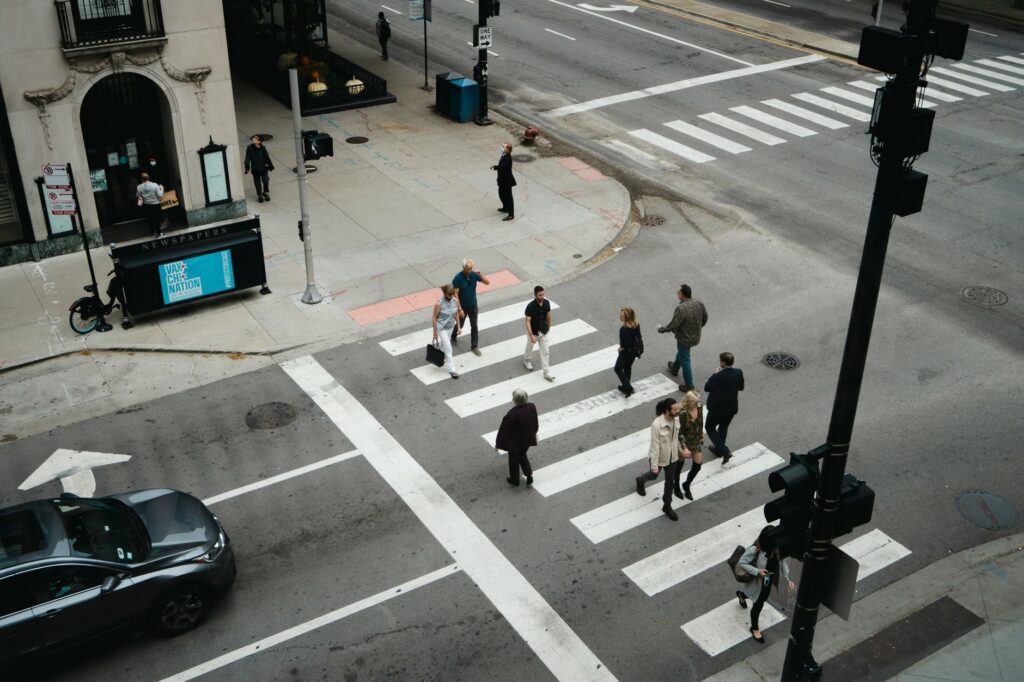
Vehicle Code 21950 requires drivers to yield to a pedestrian crossing in a marked crosswalk or in an unmarked crosswalk at an intersection. A driver approaching a pedestrian in a crosswalk must use all due care and slow down or take other action needed to protect the pedestrian. Pedestrians must also use due care: they may not suddenly step off a curb into the path of a vehicle so close that it is an immediate hazard, or unnecessarily stop or delay traffic in a crosswalk. Our posts on California crosswalk laws and unmarked crosswalk rules cover these situations in detail.
Outside a crosswalk
Under Vehicle Code 21954, a pedestrian crossing anywhere other than a marked or unmarked crosswalk must yield to vehicles close enough to be an immediate hazard. The same section says this does not relieve the driver of the duty to use due care for any pedestrian on the roadway.
Jaywalking under current law
Vehicle Code 21955 still says pedestrians should cross only in a crosswalk between adjacent signal-controlled intersections. But a peace officer may not stop a pedestrian for that violation unless a reasonably careful person would realize there was an immediate danger of a collision. The statute also keeps both duties in place: pedestrians must use due care for their own safety, and drivers must use due care for pedestrians. Our article on California jaywalking law explains the change.
Fault and compensation for a pedestrian hit by a car
A pedestrian hit by a car does not need to be blameless to recover. California uses comparative fault, described in CACI No. 405 and grounded in Li v. Yellow Cab Co. (1975) 13 Cal.3d 804. If the driver proves your own negligence contributed to your harm, your damages are reduced by your percentage of responsibility. For example, if a jury found you 20 percent responsible, your award would be reduced by 20 percent.
Common driver-side issues include distraction, impairment, speeding, fatigue and failing to watch for people at intersections and crosswalks, all of which Dermendjian raised on air. Common pedestrian-side arguments include crossing outside a crosswalk, stepping out suddenly and visibility at night.
What a claim can include
Dermendjian noted that injured pedestrians may be entitled to compensation for medical expenses, lost wages, pain and suffering and other damages, depending on the circumstances. California’s damages instructions separate economic losses, such as medical bills and lost earnings, from noneconomic losses. Under CACI No. 3905A, noneconomic damages include physical pain, mental suffering, loss of enjoyment of life, disfigurement, physical impairment, anxiety and emotional distress, and no fixed standard exists for setting the amount.
Deadlines
- Two years to file most injury lawsuits under Code of Civil Procedure 335.1.
- Six months to present a written claim if a public entity is involved, such as a city bus or county vehicle, under Government Code 911.2.
Our pedestrian accident attorneys can explain how these rules apply to your facts.
Pedestrian safety tips from the segments
Dermendjian has described road safety as a shared responsibility, and the best outcome is never becoming a pedestrian hit by a car at all. Her tips, drawn from the July 2026, December 2025 and December 2024 segments:
If you are walking:
- Do not assume a driver sees you, even when you have the signal.
- Look both ways, watch the traffic signals and stay aware of your surroundings.
- Use crosswalks and avoid crossing outside designated areas.
- Avoid dark clothing at night.
If you are driving:
- Stay alert where people are likely to be walking, including parking lots, crosswalks and neighborhoods.
- Put the phone away and avoid other distractions.
- Never drive impaired, and treat drowsiness as impairment, especially on long summer road trips.
- Slow down at intersections and crosswalks.
Key takeaways
- If you are a pedestrian hit by a car, get medical care first, then gather the driver’s information, witness details and photos.
- California drivers must stop, exchange information and render reasonable assistance after an injury crash.
- Drivers must yield in marked and unmarked crosswalks, and they always owe pedestrians due care.
- Pedestrians outside a crosswalk must yield to vehicles that are an immediate hazard, but their own fault reduces damages rather than automatically ending a claim.
- Most lawsuits must be filed within two years, and claims involving a public entity have a six-month presentation deadline.
Frequently asked questions
Do pedestrians always have the right of way in California?
No. Drivers must yield to pedestrians in marked crosswalks and unmarked crosswalks at intersections, but a pedestrian crossing outside a crosswalk must yield to vehicles that are close enough to be an immediate hazard. Drivers still owe pedestrians due care in every situation.
Can I still recover if I was jaywalking when I was hit?
Possibly. California uses comparative fault, so a pedestrian’s own share of responsibility reduces the damages rather than automatically barring them. The driver’s duty to use due care toward pedestrians in the roadway still applies.
How long do I have to file a claim after a pedestrian accident?
Most California personal injury lawsuits must be filed within two years under Code of Civil Procedure 335.1. If a public entity, such as a city or county vehicle, is involved, a written claim generally must be presented within six months under Government Code 911.2.
What should I collect at the scene if I can?
The driver’s name, home address and vehicle registration number, the owner’s name and address, insurance information, witness names and phone numbers, and photos of the vehicle, the crosswalk or roadway, traffic signals, lighting and your injuries.
Talk to a California injury attorney
If you have questions about your own situation, a conversation with an attorney can help you understand your options and the deadlines that apply. Call (888) 977-2238 or contact us online.
Attorney advertising. This article is general information, not legal advice. Reading it or contacting us does not create an attorney-client relationship. Every case is different, and results will differ based on different facts. Past results do not guarantee a similar outcome, and no result is guaranteed. B&D Law Group, APLC, Los Angeles office: 10700 Santa Monica Blvd, Suite 200.
Related Reading
- Pedestrian Killed in Van Nuys Hit-and-Run on Victory Boulevard (Nov. 5, 2026)
- 3 Killed When Minivan Hits Pedestrians and Vendors at North Hollywood Metro Station (Nov. 10, 2026)
- Clocks Fall Back Nov. 1: Darker Evenings, Higher Crash Risk and Your Rights in California
- Halloween Falls on a Saturday: Pedestrian Safety and Your Rights in California
- Pedestrian Accident Attorneys — B&D Law Group
One Response
If you’ve been hit as a pedestrian, or seen it happen, what’s one thing you wish you had known in the first hour?