

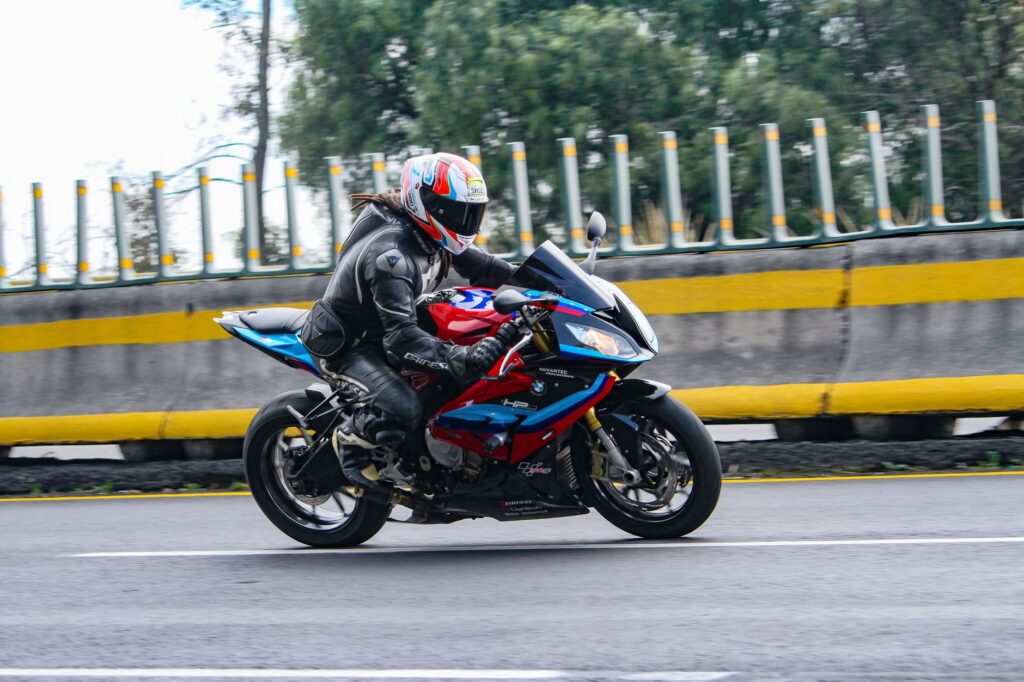
After a motorcycle crash in California, stop at the scene, call 911, exchange information, and photograph the roadway and your bike before anything is moved. Get examined the same day even if you feel fine, keep your helmet and gear untouched, and decline to give the other driver’s insurer a recorded statement. Two reports also come due fast: a written injury report to law enforcement within 24 hours under Vehicle Code section 20008, and an SR-1 to the DMV within 10 days under section 16000.
We are B&D Law Group, APLC, and we represent injured riders across California. Motorcycle claims do not behave like car claims: the injuries are worse, the physical evidence is fragile and gets thrown out within days, and adjusters open the file already assuming the rider was speeding or weaving. The steps below follow the first week in order.
Stop, Secure the Scene, and Meet Your Duties Under the Vehicle Code
Vehicle Code section 20001 requires the driver of a vehicle involved in an accident resulting in injury to another person, or in a death, to immediately stop and fulfill sections 20003 and 20004 (identifying yourself and rendering reasonable assistance). That duty applies to you as a rider, not only to the driver who hit you. Leaving is punishable by state prison or up to a year in county jail, a fine of $1,000 to $10,000, or both, and where the crash caused death or permanent, serious injury, by two, three or four years in state prison or 90 days to a year in county jail, a fine of $1,000 to $10,000, or both.
Get out of the live lane if you safely can, and stay put if you cannot. Call 911 rather than agreeing to handle it privately: an apologetic driver becomes a different person once an insurer is involved. If you have neck or back pain, do not let a bystander pull your helmet off. Exchange names, registration, license, and insurance details, then collect phone numbers from witnesses before they leave.
The Two Reports California Requires, and the Clocks Running on Them
California imposes two separate reporting obligations, on different clocks and to different agencies, and both fall on the rider or driver rather than the officer. Vehicle Code section 20008 requires the driver of a vehicle involved in any accident resulting in injuries to or death of any person to make, or cause to be made, a written report within 24 hours, to the California Highway Patrol, or, if the crash occurred within a city, to either the CHP or that city’s police department. Vehicle Code section 16000 separately requires an SR-1 report to the DMV within 10 days when anyone is injured or killed, or when property damage exceeds $1,000.
| What is due | Deadline | Who receives it | Authority |
|---|---|---|---|
| Stop, identify yourself, render aid | Immediately, at the scene | The other parties involved | Veh. Code §§ 20001, 20003, 20004 |
| Written report of an injury or fatal crash | 24 hours | CHP, or city police if the crash was in a city | Veh. Code § 20008 |
| SR-1 report of traffic accident | 10 days | California DMV | Veh. Code § 16000 |
| Claim against a public entity | 6 months | The public entity | Gov. Code § 911.2 |
| Personal injury lawsuit | 2 years | Superior Court | Code Civ. Proc. § 335.1 |
Get Examined the Same Day, Because Adrenaline Hides Injuries
Riders routinely walk away from a crash, decline the ambulance, and wake up two days later unable to turn their head. The surge of stress hormones after a crash suppresses pain perception for hours, and concussion, internal bleeding, and disc injuries can all present quietly at the roadside and loudly on day three. According to NHTSA’s Traffic Safety Facts publication, Motorcycles: 2023 Data, the motorcyclist fatality rate per 100 million vehicle miles traveled in 2023 was 31.39, almost 28 times the passenger car occupant rate of 1.13. Riders absorb crash forces with their bodies.
A gap between the crash and the first medical visit is an adjuster’s most reliable argument: if you were really hurt, you would have gone in. Go to an emergency room or urgent care the same day, describe how the crash happened rather than just where it hurts, and mention every symptom.
Preserve the Helmet, the Gear, and the Bike
Your helmet is evidence, and it is the piece riders throw away first. Scuffs, cracks, and paint transfer on the shell show where your head struck, often the only proof of a head impact when imaging looks unremarkable. Do not clean it, repaint it, or wear it again. Photograph it from every angle, then box it. Do the same with your jacket, gloves, and boots, whose abrasion patterns show which way you slid.
Insurers move fast to total a bike and dispose of it, and once a salvage yard has it the frame measurements are gone. Photograph the bike where it lies and again in storage, and tell your insurer in writing not to repair, sell, or scrap it until it is inspected. Photograph the roadway too: skid and gouge marks, fluid trails, the debris field, vehicle positions, traffic controls, and sightlines from the direction the other driver approached. If a pothole, lane seam, gravel, or missing sign contributed, photograph it with something in frame for scale, because road defect claims run against a public entity, and Government Code section 911.2 gives you six months to present one.
Do Not Give the Other Driver’s Insurer a Recorded Statement
Within a day or two, an adjuster for the other driver will call. The request sounds administrative: a quick recorded statement to get your claim moving. You are not obligated to give one. That adjuster works for the person who hit you, and the recording exists to be quoted back at you later.
The questions are built for that purpose. “How fast were you going?” invites a guess that becomes your admission. “Did you see him before impact?” sets up an argument that you could have avoided the crash. “Were you between lanes?” opens the lane splitting attack. Decline politely, give only the date and location, refer questions to your attorney, and sign no blanket medical authorization. Your own insurer is different: your policy requires prompt notice and cooperation.
Three Traps That Are Specific to Riders
The helmet question. Vehicle Code section 27803 requires a driver and any passenger to wear a safety helmet meeting the requirements of section 27802, fastened and fitted so it does not move excessively. Riding without one is a violation, but it is not a bar to a claim. California applies pure comparative fault under Li v. Yellow Cab Co. (1975) 13 Cal.3d 804, where the injured person’s own negligence reduces damages in proportion to fault rather than defeating recovery. Whether it reduces a particular award depends on whether it contributed to the injuries claimed (a broken femur has nothing to do with headgear), and how far that argument reaches is fact-specific and contested.
Lane splitting. Splitting is lawful in California. Vehicle Code section 21658.1, added by Assembly Bill 51 in 2016, defines it as driving a motorcycle with two wheels on the ground between rows of stopped or moving vehicles in the same lane, and authorizes the CHP to develop educational guidelines. It sets no speed limit and no speed differential, despite the widely repeated claim that a 10-mph rule exists. What it does not do is exempt you from the basic speed law in section 22350, so insurers argue instead that a lawful maneuver was performed unreasonably.
Your own citation. A ticket at the scene is not an adjudication of civil fault, and even genuine fault does not end the claim. Under Li, a rider found 30 percent responsible still recovers 70 percent. One real limit applies: Civil Code section 3333.4, enacted by Proposition 213, bars non-economic damages (pain, suffering, physical impairment, and disfigurement) for an owner whose vehicle was uninsured or an operator who cannot establish financial responsibility. Economic damages such as medical bills and lost wages remain recoverable, and the statute excepts an uninsured owner injured by a driver convicted of DUI.
Frequently Asked Questions
Do I have to report a motorcycle accident to the police in California?
If anyone was injured or killed, yes. Vehicle Code section 20008 requires a written report within 24 hours to the California Highway Patrol, or, when the crash happened inside a city, to either the CHP or that city’s police department. Section 16000 separately requires an SR-1 filed with the DMV within 10 days. Call 911 even when nobody appears hurt: it creates an independent record and brings paramedics.
What happens if I was not wearing a helmet in a California motorcycle accident?
You can still bring a claim. Vehicle Code section 27803 requires helmets for riders and passengers, so riding without one is a traffic violation, but California uses pure comparative fault under Li v. Yellow Cab Co., which reduces your recovery proportionally rather than barring it. How much it reduces recovery, if at all, turns on whether the missing helmet contributed to the injuries you claim; orthopedic and internal injuries generally have no connection to helmet use.
Can I still recover compensation if I was lane splitting when the crash happened?
Yes. Lane splitting is legal in California under Vehicle Code section 21658.1, which defines the practice and sets no speed limit and no speed differential, so an insurer cannot make you at fault simply because you were between rows of vehicles. What it will argue is that the way you split was unreasonable, raising speed relative to traffic, lane position, visibility, and gap size. Photographs and camera footage answer that argument.
Should I talk to the other driver’s insurance company after a motorcycle crash?
You are not required to give a recorded statement to the other driver’s insurer, and you generally should not. That adjuster represents the person who hit you, and the recording is taken to show you were speeding, inattentive, or uninjured. Give the date, location, and vehicles involved, then direct substantive questions to your attorney. Do report the crash promptly to your own insurer, because your policy requires notice and cooperation.
How long do I have to file a motorcycle accident claim in California?
For most claims against another driver, Code of Civil Procedure section 335.1 gives you two years from the date of injury to file suit, though waiting that long is a mistake because camera footage and the motorcycle itself disappear within weeks. If a public entity may share responsibility, such as a road defect or a government vehicle, Government Code section 911.2 requires a written claim within six months, and missing it can end an otherwise strong case.
If you were hurt in a crash, our team can take over the deadlines, the evidence preservation, and the adjuster calls while you treat. Learn how we handle motorcycle accident claims, car accident claims, and catastrophic injury cases, or contact us at (888) 977-2238.
This article is provided for general informational purposes only and does not constitute legal advice. Reading it does not create an attorney-client relationship. Every case is different and past results do not guarantee a similar outcome. If you have been injured, speak with a licensed attorney about your specific situation.