

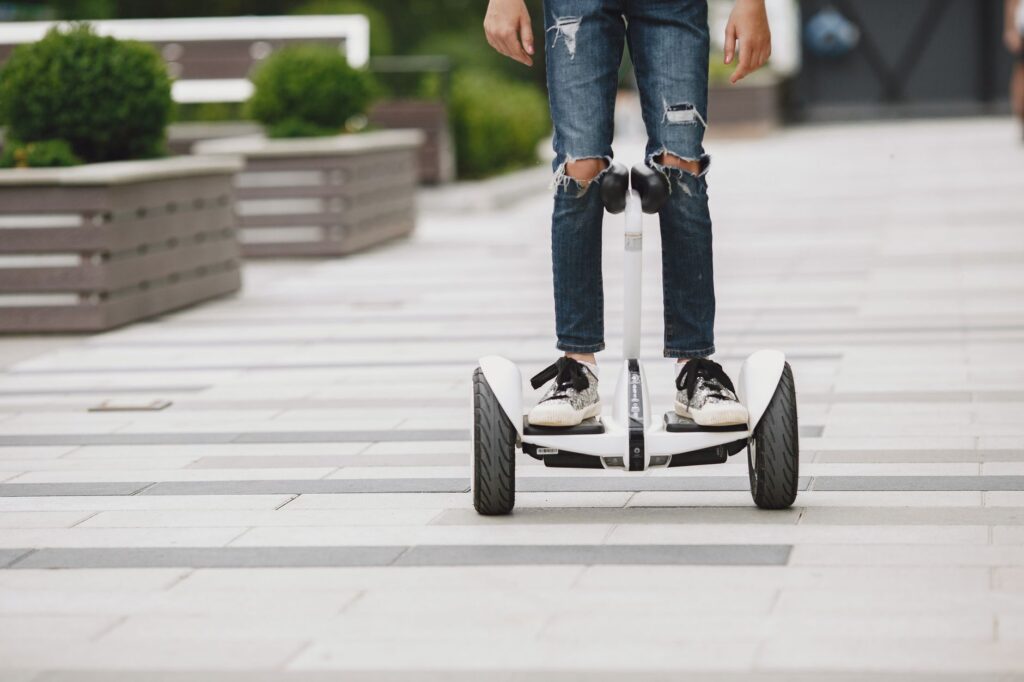
In California you may ride a hoverboard on a street posted at 35 miles per hour or less, or entirely within a Class II or Class IV bikeway, if you are at least 16, wearing a bicycle helmet, and riding no faster than 15 miles per hour. Those rules come from Vehicle Code sections 21291, 21292 and 21294, which govern what the statute calls an “electrically motorized board.” Two very different injury claims can follow: negligence after a collision, and strict product liability when the battery overheats and burns.
We are B&D Law Group, APLC, a personal injury firm representing clients in California and in Las Vegas, Nevada. Hoverboard riding reaches our team two ways: a rider knocked down at an intersection, and a family whose home burned while a board sat charging. The defendants, the proof and the available insurance are entirely different.
Where Hoverboard Riding Is Legal in California
The Vehicle Code never says hoverboard. Section 313.5 defines an “electrically motorized board” as a wheeled device with a floorboard designed to be stood upon, not greater than 60 inches deep and 18 inches wide, built for one person, with an electric propulsion system averaging less than 1,000 watts and a maximum speed of no more than 20 miles per hour. Article 7 of Division 11 supplies the operating rules:
| Section | What it requires |
|---|---|
| § 21290 | Definitions; “bikeway” per Streets and Highways Code § 890.4. |
| § 21291 | Rider must be 16 or older. |
| § 21292 | Bicycle helmet meeting the § 21212 standard on a highway, bikeway, path, sidewalk or trail. |
| § 21293 | After dark: front lamp visible 300 feet, rear reflector 500 feet, side reflectors 200 feet. |
| § 21294 | Highways posted 35 mph or less unless within a Class II or IV bikeway; 15 mph ceiling. |
| § 21296 | Riding under the influence is unlawful; fine of not more than $250. |
Two things surprise people. Nothing in Article 7 requires a driver’s license, registration or liability insurance, and we found no other Vehicle Code provision imposing one, so no auto policy usually stands behind a rider who hurts someone. Section 21295, which had required a California Highway Patrol report to the Legislature, was repealed effective January 1, 2025.
Crash Claims: Rider Hit by a Car, or Rider Hits a Pedestrian
A collision case is ordinary negligence: Civil Code section 1714(a) requires everyone to use ordinary care. If a driver turned across a bike lane and knocked a rider down, the driver’s auto liability policy comes first, though California’s SB 1107 minimums of $30,000 per person, $60,000 per accident and $15,000 property damage, in force for policies issued or renewed on or after January 1, 2025, often fall short. Under Li v. Yellow Cab Co. (1975) California applies pure comparative fault, so a rider found 30 percent at fault still recovers 70 percent.
Insurers hunt for Article 7 violations, because a statutory violation can support a negligence per se argument where the statute was meant to prevent that harm. Whether a helmet violation reduces a head-injury recovery on one of these boards is not a question California appellate courts have squarely resolved, so discuss it with a lawyer. When a rider strikes a pedestrian the rider becomes the defendant, and an auto policy generally will not respond, though a homeowners or renters policy sometimes does.
Battery Fire and Defect Claims: Strict Product Liability
Fire cases are a different animal. A lithium-ion pack in thermal runaway gives a sleeping family almost no warning, and the burns and property losses dwarf what a fall produces. Under Greenman v. Yuba Power Products (1963) a manufacturer that puts a defective product on the market knowing it will be used without inspection is strictly liable for the resulting injuries, without proof of carelessness. Vandermark v. Ford Motor Co. (1964) extended that liability to retailers, and Barth v. B. F. Goodrich Tire Co. (1968) applied it to a distributor, which matters because many hoverboard brands no longer exist.
Three defect theories run in parallel. A manufacturing defect means this unit departed from its own design. A design defect is tested two ways under Barker v. Lull Engineering Co. (1978) 20 Cal.3d 413: the product failed to perform as safely as an ordinary consumer would expect when used in an intended or reasonably foreseeable manner, or the defendant fails to establish that the design’s benefits outweigh its inherent risk of danger once you show the design caused the injury, a prong that shifts the burden to the manufacturer. A failure-to-warn claim asks what was disclosed; under Anderson v. Owens-Corning Fiberglas Corp. (1991) 53 Cal.3d 987, actual or constructive knowledge of the risk is a required element.
Recall history is powerful proof of what the industry knew and when. On July 6, 2016 the U.S. Consumer Product Safety Commission announced that 10 firms were recalling roughly 501,000 self-balancing scooters whose battery packs could overheat and risk fire or explosion, citing at least 99 reported incidents. On March 30, 2023 the CPSC recalled about 53,000 Jetson Rogue boards after an April 1, 2022 fire in Hellertown, Pennsylvania killed a 10-year-old girl and her 15-year-old sister. Its micromobility report for 2017 through 2024 estimated 163,300 emergency-department-treated injuries tied to self-balancing scooters and attributed eleven deaths to fires involving them.
The governing standard is ANSI/CAN/UL 2272, covering the drive train, battery and charger systems of personal e-mobility devices. In a December 19, 2022 letter to manufacturers, importers, distributors and retailers, the CPSC said consumers face an unreasonable risk of fire and serious injury or death from devices that do not comply, and reported at least 208 fire or overheating incidents across 39 states between January 1, 2021 and November 28, 2022, with at least 19 deaths, 11 involving hoverboards. That letter is evidence of both the standard of care and notice, and the CPSC says compliance significantly reduces the risk of injuries and deaths from micromobility device fires.
When the Rider Is a Minor: Who Is Legally Responsible
Section 21291 sets a floor of 16 years of age, so a 12-year-old riding on the sidewalk is violating the statute, and an injured pedestrian will look past the child to the adults. The Vehicle Code’s parental liability provisions are narrower than they appear. Section 17707 makes the adult who signed a minor’s driver’s license application jointly and severally liable for the minor’s negligent driving of a motor vehicle, but a hoverboard rider files no such application. Section 17708 reaches a parent or guardian for a minor’s liability arising out of driving a motor vehicle upon a highway with permission.
Whether an electrically motorized board is a “motor vehicle” for that purpose is genuinely unsettled. Section 415(a) defines a motor vehicle as a vehicle that is self-propelled, which a hoverboard plainly is, but neither section 313.5 nor Article 7 answers the question, and we located no published California decision applying section 17708 to one. Nobody should count on it. Civil Code section 1714.1 is steadier: it makes parents liable for a minor’s willful misconduct, though it caps that liability at an amount the Judicial Council adjusts for inflation. The stronger claim is usually direct negligence against the parent for negligent supervision or entrustment, which is the parent’s own conduct and is not capped.
Fires That Start in a Rental Unit or Hotel Room
When a charging board ignites in an apartment, short-term rental or hotel, the product claim leads but a premises claim can run alongside. Civil Code section 1714(a) requires ordinary care in managing property, and a landlord or hotel operator is measured by what it controlled and what it knew. Blocked exits, disabled smoke alarms or ignored complaints can put an operator on notice of a foreseeable hazard it had a reasonable opportunity to address. An owner who was never told and had no way to know stands in a very different position.
The Evidence That Decides These Cases
Physical evidence decides fire claims. Do not discard the board, battery pack, charger, carton or order confirmation, however ruined: the burned remains are what an origin-and-cause engineer examines. Get the fire department’s incident report and photograph the seller listing before it disappears.
Frequently Asked Questions
Can you ride a hoverboard on the sidewalk in California?
The Vehicle Code contemplates it: section 21292 requires a bicycle helmet on a highway, bikeway, public bicycle path, sidewalk or trail, and section 21294(b) caps speed at 15 miles per hour on those surfaces. Section 21294(a) limits highway riding to streets posted at 35 miles per hour or less unless you stay within a Class II or Class IV bikeway. Cities, campuses and private property owners often restrict sidewalk riding.
Do you need a license or insurance for hoverboard riding in California?
No provision in Article 7 requires a driver’s license, registration or liability insurance for an electrically motorized board, and we found no other Vehicle Code section imposing one. The statute requires age 16 or older, a bicycle helmet, the 15 mile per hour ceiling, streets posted at 35 miles per hour or less, lighting after dark, and no riding under the influence. With no auto policy behind the rider, the only coverage may be a homeowners or renters policy.
Who can be sued when a hoverboard battery catches fire?
Everyone in the chain of distribution. Under Greenman v. Yuba Power Products (1963) the manufacturer is strictly liable for a defect that causes injury, and under Vandermark v. Ford Motor Co. (1964) and Barth v. B. F. Goodrich Tire Co. (1968) that liability reaches retailers and distributors, which matters because many hoverboard importers have dissolved. The claim can proceed on manufacturing defect, design defect under either prong of Barker v. Lull Engineering Co. (1978), or failure to warn under Anderson v. Owens-Corning Fiberglas Corp. (1991).
Does a UL 2272 mark on the box defeat a hoverboard fire claim?
No. Compliance with ANSI/CAN/UL 2272 is evidence a defendant will use and bears on the risk-benefit prong of the design defect analysis, but it is not a defense standing alone; the CPSC says only that compliance significantly reduces the risk of injuries and deaths from micromobility device fires. The mark also has to be genuine, since counterfeit safety markings appear on imported micromobility products.
How long do you have to file a hoverboard injury claim in California?
Two years from the date of injury under Code of Civil Procedure section 335.1. If the injured person was a minor, section 352(a) excludes the period of minority from that calculation, which is why some childhood burn claims remain viable long after the ordinary deadline. A claim against a public entity requires an administrative claim within six months under Government Code section 911.2.
If a hoverboard fire burned you or your child, or a collision left you with injuries you are still paying for, our team can tell you which claims are available and what to preserve now. We handle product liability claims, premises liability claims and catastrophic injury cases involving severe burns. Call (888) 977-2238 or reach us through our contact page. Bring the board, whatever is left of it.
This article is provided for general informational purposes only and does not constitute legal advice. Reading it does not create an attorney-client relationship. Every case is different and past results do not guarantee a similar outcome. If you have been injured, speak with a licensed attorney about your specific situation.